
Populism in the UK: Features and Future Implications
di Frankie Watson-Brown | University of Strathclyde
Tempo di lettura 10'
British Political Evolution
Evolving political landscapes and trends require effective academic responses. In doing so, researchers can more aptly understand and analyse the nature of rhetoric, campaigning, and governance by acquiring all available information, and designing efficient tools of evaluation. Populism, in turn, is a subsection of academia that has become increasingly fragmented and divided in recent years. Specifically, British politics has found itself in an unprecedented state of governance. The incumbent government, a large-scale parliamentary majority for Keir Starmer’s Labour party, is facing poll-centric pressure from populist figurehead and ever-present euro- sceptic Nigel Farage, and his newest party, Reform UK. It is suggested that the British political process is experiencing a populist radicalisation stemming largely from policy enacted by previous
governments, such as the Rwanda Policy 1ª(Bonansinga & Forrest, 2025). Important to note, is not the policy in and of itself, but rather the approach that is required by policymakers, and members of parliament, to ensure its implementation. Policy implementation is a by product of policy legitimation (Cairney, 2017). Legitimation of policy proposals also requires communication between members of parliament to ensure it is successful (the final stage of Cairney’s (2017) policy cycle). Therefore, it is relevant when discussing populism and its apparent rise, or ’peak’ (Ansell, 2025) in the UK, to understand fully the rhetoric that is deployed in governance as well as how this effects policy outcomes and election-time campaigns. This article predominantly considers the deployment of populist rhetoric, and terminology – with the view to evaluate any ‘peak’ in the form of changing use(s) and definitional variations in recent times. This is important because by understanding how the term(s) have changed, if at all, we can better understand if a ‘peak’ (Ansell, 2025) has occurred, whereas in evaluating electoral results, or party-policy programmes, results are limited to those given a mandate by voters. This further prevents us understanding the arenas in which populism thrives, out with the central authority of a state.
Contextual Research, Background, & Definitional Issue
Within this we take populism to be a discoursal concept and to effectively grasp the changing nature of it, we must look at previous quantitative academic datasets, which aim to understand volatile trends using terminology derived from dictionary definitions of the term (Bonikowski, 2015) (this is particularly helpful to avoid any further debate). Importantly, treating populism as a ‘moment’ (Laclau, 2005; Mouffe, 2018) allows us to express populism as flexible, and it is most appropriately understood as a strategy that can be deployed across the political spectrum at different times, such as the audience being communicated to during a local campaign, versus that of an international address (Hawkins, 2019). In defining the flexibility of the term, we can also operationalise it in this study at a later stage.
The importance of choosing a definition of ‘populism’ is founded on the fact that academics in the field remain largely divided on a singular, agreed upon interpretation of the term. As such, for sake of clarity, here we understand it to mean a discoursal ‘moment’ (Laclau, 2005) rather than alternating between denotations of specific phrases, ideologies, or symbols. This allows for a flexible understanding of a ‘rise’ in UK-based populism without constraining the conclusions made.
Methodology
The intention of this work is to understand and identify any shifts in populist rhetoric in recent years, linking any changes to the claims of scholars that a ‘peak’ has been seen in populism in that same period. For the sake of clarity, we will define this as the years 2000 to 2025. To effectively address our research area, our central focus will lie on Nigel Farage and the Reform UK agenda and rhetorical approach. The timeframe selected for use means that anyanalysis conducted can be evaluated based on changes in communication, dependent on the societal bête noire of the age 2ª.
Moreover, Farage can be aptly described as an individual who “articulates a popular democratic story that is antagonistic to the dominant liberal ideology” (Laclau, 2005; Sharlamanov, 2022), that can be found across the British Isles.
The most reasonable explanation for the selection of Farage is his predisposition to character-defining trends considered ‘populist’ in nature. His speeches rank highly for the use of terms contained in quantitative and qualitative research that already exists (Hawkins, 2019; Bonikowski, 2015) and adapt to evolving political trends. Furthermore, this lends itself to the classical definition of Laclau (2005), that populism is simply a method of “constructing the political.”
This is relevant, as in ‘constructing’ a rhetorical shift; policy outcomes are affected. As such, the entire UK political system experiences a perceivable change, as discourse becomes divisive, populism becomes legitimate, and the status quo becomes what has been ‘constructed.’
Analysis and Conclusions
The central point of this work is to identify any real shift in the rhetoric of ‘populist’ figures, in this case Reform UK leader Nigel Farage, and effects on the British political system. To do so, the following conclusions suggest a reasonable shift, and identifiers for current and future impacts on governance and policymaking, as a direct result of populism.
1. Rhetoric has been consistent when referencing specific topics. These include – renewal, betrayal (of previous administrations), etc – but it is inconsistent regarding topics like the ‘elites’ of a nation. We can proscribe this relative inconsistency with the subjects chosen for evaluation – as Farage, and other right-wing MPs in the UK are often from wealthier backgrounds (Murray, 2023).
2. An issue for evaluating the future implications of populist rhetoric on British politics, and indeed worldwide, is the lack of homogeneity in rhetorical approaches. Leaders considered ‘populist’ such as Donald Trump, Giorgia Meloni, and Geert Wilders, have all experienced a ‘contact point’ with governance. When the populist is eventually elected to a
position of power, their communication style begins to change, likely because compromises must be reached in office, and this is made far more difficult when using populist terms that are often inherently divisive. However, Farage stands out globally, as his rhetoric has so constantly shifted to fit the mould he believes to be required, analysis can become difficult. One of the only consistencies identified in his speeches is that of a “collective narcissism” (Bull, Weinberg & Coen, 2024), or the self- adoration of values considered to have been lost to the waves of time. In creating this identification, on the proposition that previous governments (such as the Conservative & Labour parties) have “betrayed” the ‘people’ of Britain, Farage can inspire out-group rejection or conductmwhat scholars have referred to as a ‘priming procedure’ (Mummendey & Klink, 2001). This involves fostering an environment in which the rhetoric used inspires feelings within the electorate that are inherently nationalistic, or protectionist. There is a definitive link between nationalistic feelings and out- group rejection (Mummendey * Klink, 2001).
3. Out-group rejection and use of terms such as ‘they,’ ‘them,’ and ‘we’ pose significant questions for the future of the UK’s two-party system. Reform UK, in speeches in the City of London (2025), Wales (2025), and parliamentary maddresses since 2024, have successfully merged both the Conservative party and the Labour party as a relative ‘threat’ to the British people. Statements such as “the political class is running the economy off a cliff.” And “we are the party of alarm clock Britain, not Rachel Reeves, and certainly not the Conservatives,” allow for both major parties to be combined, regardless of ideology, whereafter Reform UK propose themselves as the only “solution” to the governance problem that the voter faces. If this is to continue, we can look to the success of Reform UK in the 2024 parliamentary elections, in which the party received over four million votes, and gained five parliamentary seats as evidence for the effectiveness of this approach. Their continued influence on general debate in Britain also gives rise to the idea that the traditional two-party system in one of the world's oldest democracies may be faltering.
4. In using ‘populist’ language – terms such as us, they, betrayal, renewal, and the people – what is considered ‘political’ by nature begins to change. Looking back to the definition of populism with which this paper is based upon, that populism is “a way of constructing the political”(Laclau, 2005), and that it is more a “moment” in politics, rather than a constant phenomenon (Laclau, 2005), we can draw objective conclusions. If rhetoric is. used to construct a narrative in the political sphere, especially from ‘outsider’ parties such as Reform UK, dominant ones such as the current Starmer-led Labour party are left with the option to either disregard it as a fleeting trend of discourse, or engage as to treat it as a serious threat. As has been mentioned, policy implementation by previous governments (such as the Rwanda plan), has resulted in populist resurgence, and as such it is in this work’s belief that the British political system has made a decision towards the latter, to validate populist rhetoric shifts and engage on the same level.
Conclusion: Future Implications & Considerations
Overall, a case has been created to suggest that UK politics has begun experiencing a level of change relatively unprecedented in previous decades. The catalyst of this change is undoubtedly the populist resurgence, specifically with reference to Nigel Farage, outsider politics, and the rhetoric of divisive parliament members/policymakers. Using rhetoric as a method of gaining legitimacy, Farage has for the first time in his long-standing political career received a directive from regional electors to stand as a Member of Parliament (for Clacton on-Sea, a region he had not previously stood for election).
This suggests a serious and momentous change in the effects of populism on tangible, electoral results. Previously, suggestions that populism was producing effects on the British political system were limited to policy responses, and general language used sparingly in parliament and media interactions. Now, its evolution is expansive, and the ‘moment’ (Laclau, 2005) in which it is viewed is considerably more difficult to pinpoint.
For the future of British politics, some implications must be considered. Mainly, that of the incumbent Starmer administration, which holds a large-scale parliamentary majority, but is experiencing considerable polling issues, amid the rise of Farage’s populist approach. As such,it is of a critical importance that not only the Labour party, but British politics as a collective do not fall prey to populism and rhetorical shifts which invite mass divide.
If mistakes are repeated, similar to that of the Conservative party during the Brexit referendum, through to the controversial and now retracted Rwanda Plan, populist communication styles are likely to thrive. Important to note, is that populism is not right-wing ideology, and can apply across the political spectrum, and in turn it is not simply a negative ideological position, communication style, or ‘moment.’
However, for the future of British politics the avoiding of rhetoric-sharing is crucial, as Reform UK’s populist iteration is propagated on the idea of nationalism, betrayal, and out-group rejection. These characteristics only serve to further deepen a divide and return to a nation that no longer exists. Populism must be understood clearly, as it is deployed in various forms, we must take each leader, party, and campaign as a different case to be studied and evaluated.
1ª - Rwanda Policy – Proposed by various Conservative governments between 2022 and 2024, would have seen asylum seekers in the UK rerouted to Rwanda for processing and possible long-term stay.
2ª - Farage’s political career began with the ‘Save the Pound’ campaign, an early iteration of euroscepticism, followed by other social issues such as the 2016 Brexit 2ª referendum, the Covid-19 pandemic, mass immigration, and protests in the UK regarding asylum seekers housing. Farage is consistently adapting to fit these trend.
Bibliografia
- 1. Ansell, B. (2025). Twilight of the Populists?
- 2. Bonansinga, D. and Forrest, C., 2025. “Stop the boats”: populist contagion and migration policymaking in the UK. Ethnic and Racial Studies, pp.1-19.
- 3. Bonikowski, B. and Gidron, N., 2015. Populism in legislative discourse: Evidence from the European Parliament. Unpublished manuscript, Harvard University.
- 4. Bull, P., Weinberg, A. and Coen, S., 2024. Populism in the UK: An Analysis of the Rhetoric of Nigel Farage. In Discourse Approaches to an Emerging Age of Populist Politics (pp. 187-202). Singapore: Springer Nature Singapore.
- 5. Cairney, P. 2017. 5 Images of the Policy Process. University of Stirling
- 6. Hawkins, K. A., Aguilar, R., Castanho Silva, B., Jenne, E. K., Kocijan, B., and Rovira Kaltwasser, C. 2019. “Measuring Populist Discourse: The Global Populism Database”
- 7. Laclau, E., 2005. On populist reason. Verso.
- 8. Mouffe, C., 2018. For a left populism. Verso.
- 9. Mummendey, A., Klink, A. and Brown, R., 2001. Nationalism and patriotism: National identification and out‐group rejection. British journal of social psychology, 40(2), pp.159-172.
- 10. Murray, R., 2023. It's a rich man’s world: How class and glass ceilings intersect for UK parliamentary candidates. International Political Science Review, 44(1), pp.13-26.
- 11. Sharlamanov, K. (2022). Populism and Liberal Democracy. In: Populism as Meta Ideology. Palgrave Macmillan, Cham.
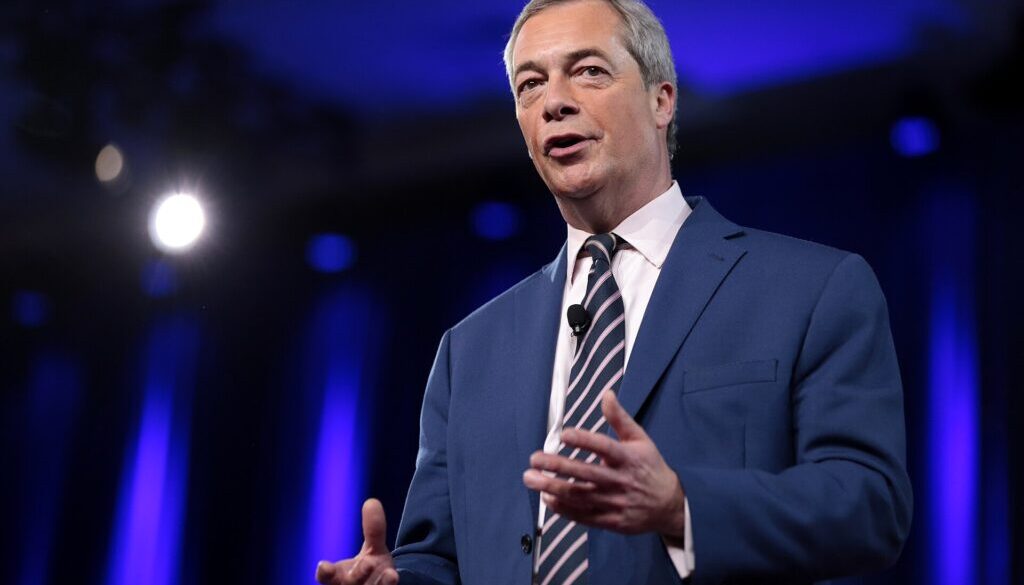
Immagine: Foto di Nigel Farage, via Wikimedia Commons, concessa con licenza Creative Commons CC BY-SA 2.0. Non modificata.


